
Growing a company rarely means hiring full-time employees for every new task. A resourcing model helps you decide who should perform the work, where capacity should sit, and how much flexibility you need. For U.S. businesses, that decision can involve employees, contractors, outsourcing partners, or a mix of all three.
Quick answer: A resourcing model is a framework for matching business demand with the people, skills, capacity, and outside support needed to deliver the work. It helps leaders decide what to keep in-house, what to outsource, and when to add employees or flexible talent. The right approach changes as demand, budgets, and priorities change.
| Area | Key question to answer |
|---|---|
| Demand | How much work must the business deliver? |
| Skills | Which capabilities are required to complete it? |
| Capacity | Does the current team have enough available time? |
| Talent source | Should the work use employees, contractors, or external providers? |
| Ownership | Who makes staffing and allocation decisions? |
| Cost | What is the complete labor and management cost? |
| Flexibility | How quickly can capacity increase or decrease? |
| Review cycle | When will assumptions and staffing needs be reassessed? |
Key Takeaways
- Start with business demand rather than an organizational chart.
- Separate permanent capability needs from temporary capacity needs.
- Centralized structures improve visibility and consistency.
- Decentralized structures can respond faster to local needs.
- Hybrid structures combine central standards with local decision-making.
- Compare full labor costs rather than salary or contractor rates alone.
- Review staffing assumptions as demand, skills, and technology change.
What Does a Resourcing Model Actually Do?
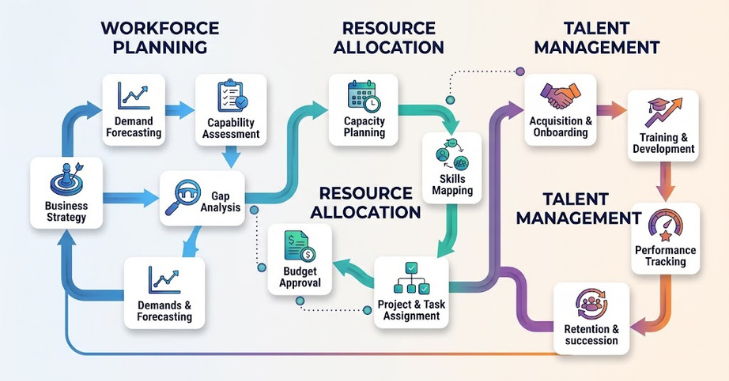
The Resourcing Model framework connects business plans with the people required to execute them. Workforce planning follows a similar principle by balancing expected labor demand against available skills and supply. IBM describes workforce planning as getting the right people, skills, places, and timing aligned with business needs.
That sounds simple, but headcount alone cannot answer the full question. Two teams with ten employees can have completely different capacity because their skills, workload, and priorities differ. Good planning therefore considers work volume, capability, availability, costs, and delivery risk together.
The process also helps companies avoid hiring before understanding the underlying problem. A capacity shortage may require more people, but a skills shortage may require training instead. Repetitive work may also be better addressed through automation or an outside specialist.
The Three Main Resource Management Structures
Businesses usually organize resource decisions through centralized, decentralized, or hybrid structures. Each structure determines who controls staffing decisions and how workers move between projects or departments. The right choice depends on company size, geographic spread, operational complexity, and the need for local decision-making.
| Structure | How it works | Main advantage | Main limitation | Often suits |
|---|---|---|---|---|
| Centralized | One function controls allocation and staffing | Better company-wide visibility | Local teams may wait longer | Firms sharing specialists across teams |
| Decentralized | Departments manage their own resources | Faster local decisions | Duplication and talent silos can grow | Independent business units |
| Hybrid | Central standards combine with local control | Balances visibility with flexibility | Responsibilities require clear boundaries | Growing multi-team organizations |
Centralized Structure
A centralized approach puts major resource decisions with one team or leader. That group can compare demand across departments and redirect capacity toward higher priorities. Standard processes can also make utilization, hiring, and reporting easier to compare.
The trade-off is distance from daily operational needs. Central planners may lack context that department managers already understand. Clear communication and current workload data are essential if this structure is going to work well.
Decentralized Structure
A decentralized approach gives managers control over their own staffing and capacity. Teams can respond quickly because decisions remain close to customers, projects, and operational problems. This independence can be valuable when departments operate in different markets or locations.
The weakness is limited company-wide visibility. One department might hire while another has underused people with suitable skills. Processes, software, and job standards can also become inconsistent between teams.
Hybrid Structure
A hybrid approach divides authority between central and local teams. Central leaders might set workforce budgets, standards, and reporting rules while managers handle everyday assignments. This can provide control without removing operational flexibility.
Recent resource-management research reflects this appeal. Runn’s 2026 survey reported hybrid structures as the most common approach among respondents, at 37%. The finding does not make hybrid structures universally superior, but it shows how many organizations combine oversight with distributed ownership.
Internal Employees, Contractors, or Outsourcing?
Organizational structure is only half of the decision. Companies also need to determine where each capability should come from. That creates a second choice between permanent employees, independent talent, outside providers, or combinations of those sources.
| Talent source | Strongest fit | Main benefit | Main consideration |
|---|---|---|---|
| Full-time employees | Ongoing core work | Continuity and institutional knowledge | Fixed employment costs |
| Contractors | Defined or temporary needs | Flexible specialist capacity | Classification and continuity |
| Outsourcing provider | Repeatable specialist services | External expertise and scalability | Vendor oversight |
| Hybrid workforce | Mixed demand patterns | Flexible blend of capability | More coordination required |
Core roles often make sense internally when they influence customer relationships, proprietary knowledge, or daily strategic decisions. Temporary demand can favor flexible talent because the need may disappear after a project ends. Specialized functions can also be sensible outsourcing candidates when internal scale cannot support dedicated expertise.
Businve’s guide to outsourcing manpower services discusses recruitment speed, flexibility, and access to external talent. Those advantages still need to be balanced against management oversight and the importance of retaining critical capabilities. The goal is to choose the source that fits the work rather than using one employment type everywhere.
How to Build a Resourcing Model in 5 Steps
A useful framework begins with work that must be completed, not existing job titles. The five steps below move from business demand toward measurable staffing decisions. Repeating them creates a planning cycle rather than a one-time spreadsheet.
1. Translate Business Goals Into Work
Start with the results the company expects during the planning period. Break each objective into projects, recurring operations, customer commitments, and support work. Then estimate how much effort each area requires.
Avoid immediately converting every workload increase into a hiring request. First determine whether the work is temporary, recurring, seasonal, or uncertain. That distinction shapes the type of capacity you should consider.
2. Map Current Skills and Available Capacity
Document who can perform each important type of work today. Include specialist skills, relevant experience, scheduled commitments, and realistic availability. A person with the correct skill but no available hours does not solve a capacity problem.
This inventory can also expose internal options before recruiting begins. Training may close some capability gaps more efficiently than external hiring. Reassignments can solve other shortages when priorities change between departments.
3. Identify the Real Gap
Compare future demand with current skills and available capacity. Separate gaps into headcount, capability, timing, and location categories. Each category can require a different response.
A skill gap might call for training or specialist help. A short seasonal spike may favor contractors rather than permanent hiring. Persistent demand across several planning cycles provides stronger evidence for adding employees.
4. Compare Ways to Fill the Gap
Evaluate internal hiring, contractors, outsourcing, automation, and workload redesign where appropriate. Compare total cost, speed, quality, flexibility, management effort, and operational risk. Do not choose solely from the most visible hourly rate.
U.S. employers should also consider payroll costs beyond stated wages. Businve’s 2026 payroll tax guide explains federal employer obligations that affect the real cost of employees. Benefits, insurance, equipment, recruiting, and management time can increase the gap further.
5. Set Measures and Review the Plan
Choose a small group of metrics tied to the purpose of the plan. Useful measures can include capacity, utilization, time to fill positions, contractor dependence, overtime, delivery delays, and labor cost. Track outcomes rather than collecting numbers without a decision attached.
Set a regular review cadence and define events that trigger an earlier review. A major contract, market slowdown, acquisition, automation project, or geographic expansion can quickly invalidate old assumptions. Planning becomes useful when leaders update it as conditions change.
Example: A Growing U.S. Service Business
Consider a 25-person professional services company expecting a major client launch. The business calculates that demand will increase for six months, especially in implementation and customer support. Management initially considers hiring six permanent employees.
Workload analysis shows only two roles will remain necessary after the launch period. The company hires two permanent employees, uses three contractors for temporary project capacity, and outsources a specialized support function. That mix limits long-term fixed costs while preserving permanent capability where demand is expected to continue.
The same approach becomes more important during geographic growth. Businesses entering new states may need local operations, leadership, and compliance knowledge at different times. Businve’s guide to expanding business operations into other states provides additional planning context for multi-state growth.
Common Resourcing Mistakes
The first mistake is starting with headcount instead of workload. Managers sometimes request another employee because a team feels busy, even when delays come from priorities or inefficient processes. Demand data makes the discussion more objective.
Another mistake is treating every worker as interchangeable capacity. Specialized skills, customer knowledge, licenses, and leadership responsibilities can make two available people unsuitable substitutes. Capacity planning therefore needs a skills view alongside a headcount view.
Companies also underestimate the cost of fragmentation. Separate departments may recruit similar talent, purchase overlapping services, or hold unused capacity without realizing it. Central visibility can reveal those problems even when managers retain local decision authority.
How Often Should the Plan Be Reviewed?
Most businesses benefit from reviewing staffing assumptions alongside their normal budgeting and operating cycles. Quarterly reviews can work well for changing environments, while stable organizations may use longer intervals. Fast-growing companies may need monthly capacity checks for critical teams.
The review should focus on assumptions rather than recreating the entire plan each time. Compare expected demand with actual demand, then examine hiring, turnover, workload, and skill changes. Update the plan when the difference becomes meaningful enough to affect delivery or cost.
Build Around the Work, Not the Org Chart
The strongest workforce decisions begin with the work customers and business goals require. Leaders can then decide which capabilities belong permanently inside the company and which can remain flexible. That sequence reduces reactive hiring and makes staffing choices easier to explain.
Treat the plan as something that changes with demand rather than a fixed organizational design. Connect workforce decisions with payroll costs, operational priorities, and expansion plans as the company grows. That discipline gives U.S. businesses a clearer path from business strategy to the people required to deliver it.
Frequently Asked Questions
What is a resourcing model?
A resourcing model explains how an organization will obtain, organize, allocate, and manage the people or external capacity needed for its work. It connects business demand with skills, workforce availability, and cost. Companies can use it for workforce planning, project delivery, hiring, and outsourcing decisions.
What is the difference between resourcing and staffing?
Staffing usually focuses on filling positions and maintaining the workforce needed for operations. Resourcing can take a wider view that includes employees, contractors, outside providers, internal assignments, and capability development. In practice, businesses often use the terms closely together.
What is the difference between workforce planning and resource planning?
Workforce planning focuses on future people and skill requirements across an organization. Resource planning often deals more directly with allocating available people to projects, teams, or workloads. Strong businesses connect both so long-term talent decisions support near-term delivery.
Is a hybrid structure better than a centralized structure?
Neither structure is automatically better for every company. Hybrid approaches offer local flexibility while retaining central standards and visibility. Centralized approaches can work better where specialists need frequent reassignment across departments.
When should a company outsource instead of hiring?
Outsourcing can fit specialist, variable, or non-core work where an external provider already has suitable expertise and scale. Permanent hiring can make more sense for recurring work tied closely to strategy, customers, or proprietary knowledge. Compare total costs, control, continuity, and expected duration before deciding.
What metrics should businesses track?
Useful measures include planned versus available capacity, utilization, labor cost, vacancies, time to hire, overtime, and project delays. The exact set should reflect the business problem being managed. A smaller group of actionable measures is usually more useful than a large dashboard.