
Every ranked list of side jobs quotes what you could earn. Almost none quote what you keep. Platform fees, mileage, unpaid setup hours, and a 15.3% self-employment tax all sit between those two numbers.
A side job is paid work you take on alongside your main income. What matters is not the advertised rate, but what survives platform fees, expenses, and tax. Plan on keeping roughly two-thirds of gross once self-employment tax and costs come out, and check how fast each option pays.
Side jobs compared at a glance
This table sorts the common routes by how the money actually reaches you. Read the last two columns first.
| Delivery and rideshare | 1099 contractor | Same week, often instant cashout | Background check, a car you already own | Fuel, mileage, wear, unpaid waiting |
| Freelance writing, design or code | 1099 contractor | 14 to 30 days after you invoice | Portfolio hours, platform commission | Unpaid pitching and revisions |
| Tutoring and coaching | 1099, sometimes W-2 | Weekly or twice a month | Background check, lesson prep | Prep time and late cancellations |
| Retail, hospitality or warehouse shifts | W-2 employee | The employer’s payroll cycle | An interview and a fixed shift pattern | Hours you cannot move |
| Renting out a room, car or gear | Self-employed or rental income | Per booking, or monthly | Cleaning, insurance, a deposit | Insurance, damage, empty weeks |
| Reselling and handmade goods | Self-employed | Once each sale clears | Inventory and listing fees | Cost of goods, shipping, returns |
Key takeaways
- Compare offers on effective hourly rate, never on the headline number.
- Set aside 25 to 30 percent of profit for tax if nobody withholds it for you.
- Profit of $400 or more in a year brings self-employment tax into play.
- Payout speed runs from same day to a month, and that alone rules some options out.
- A second job on payroll hands the tax admin back to an employer.
- Read your employment contract before you take work in the same field.
What Counts as a Side Jobs?
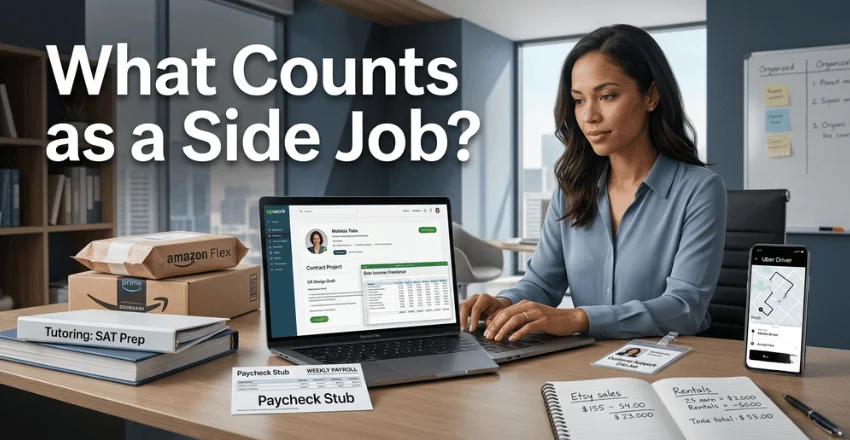
Side Jobs are any paid work outside your main income, from a second payroll job and freelance projects to occasional delivery driving. The label matters less than how the work is paid and reported. Choosing the right Side Jobs can also improve your take-home pay and flexibility.
The IRS does not care about either word. What it cares about is whether somebody employs you or pays you as a contractor. That single difference drives your tax bill, your paperwork, and how much of the rate you keep.
Work out your effective hourly rate first.
Headline rates hide the work you do for free. A $28 delivery hour with 40 minutes of unpaid waiting and $6 of fuel is not a $28 hour. Run every option through the same short formula before you give up a weekend for it.
- Add up everything the payer sent you over two weeks.
- Subtract platform commission and processing fees.
- Take off direct costs: fuel, materials, shipping, software.
- Hold back 25 to 30 percent of what is left for tax.
- Divide by every hour you spent, including admin, travel, and unpaid prep.
Do this once, and your ranking usually rearranges itself. Gross earnings of $600 in two weeks can land near $17 an hour after commission, fuel, and tax, which is a different decision from the $30 the listing advertised. Our breakdown of what $35 an hour adds up to in a year shows how quickly deductions move an annual figure too.
What the IRS takes before you do
Nobody withholds tax on contractor pay, so the bill lands later and feels bigger. According to IRS guidance on self-employment tax, the rate is 15.3%, split into 12.4% for Social Security and 2.9% for Medicare. You file Schedule SE once your net earnings from self-employment reach $400 in a year. Income tax then sits on top of that.
Report the income even when no form shows up. A client who pays you under $600 may never send a 1099-NEC. A payment app may not report a quiet year either. That money is still taxable, so set aside a share of every payment as it arrives and pay quarterly estimates once the totals get serious.
Payroll second job or 1099 contract work

These two routes carry different admin loads, and the gap is wider than most people expect. Pick deliberately instead of taking whichever offer lands first.
A second job on payroll
- Pro: tax comes out before the money reaches you.
- Pro: you get a W-2, plus workers’ compensation coverage.
- Con: fixed shifts, so your schedule stops being yours.
- Con: the rate is the rate, with no room to charge more.
Contract or freelance work
- Pro: you set the price, the hours, and the client list.
- Pro: real expenses reduce the profit you pay tax on.
- Con: self-employment tax and quarterly estimates land on you.
- Con: no sick pay, and chasing late payers is your job.
How fast the money arrives, and what it costs to start
Cash flow decides more than most rankings admit. If you took the work because a bill is due Friday, a route that pays in 30 days has failed you, whatever the rate looks like.
- Same week: delivery, rideshare, most app-based gig work.
- Weekly or twice a month: payroll shifts and tutoring platforms.
- 14 to 30 days: freelance invoices and agency subcontracting.
- Slower and lumpy: reselling, handmade goods, anything needing stock up front.
Startup cost follows the same pattern. Driving needs a vehicle and a background check. Freelancing needs samples and a few unpaid pitches, and reselling needs money on the shelf before anything sells. The future of freelance jobs looks steadier than it did a few years ago, though payment terms have barely moved.
Fitting the work around the job you already have

Read your contract before you accept anything. Some contracts include a moonlighting policy, and many add a conflict of interest clause covering competitors, company equipment and anything done during hours your employer pays for. A few employers stop outside work entirely without written approval, and licensed trades carry their own rules on top.
Then look honestly at your week and choose the block of time that fits it. Six free hours on a Sunday suit a booked tutoring session. Ninety spare minutes on random evenings suit work you can pick up and drop without losing momentum. Work that fights your energy pattern gets abandoned by week three.
The verdict: which side job to start first
Need money inside two weeks? Take the app-based work and accept the mileage. It pays fastest, needs the least setup, and tells you within two weekends whether you can stand doing it.
If somebody already pays for a skill you use at work, sell that instead. The effective rate usually beats gig platforms by a wide margin, the hours bend around you, and the second client is far easier to find than the first. Building an audience or a product is the slowest route of the three. Treat it as a project rather than a paycheck, and look at how people structure online income streams before committing your evenings to it.
FAQ
Between 25 and 30 percent of profit works as a default for most people. That covers self-employment tax and a moderate income tax band. Check it against last year’s return once you have three months of your own figures.
Yes. The $600 figure is the point where many payers must send you a form, not the point where income becomes taxable. Track every payment yourself from the first dollar.
They can restrict it. Contracts often bar work for a competitor, work using company property, and anything overlapping your paid hours. Ask in writing, and keep the reply.
Not the paycheck itself, though they can affect your withholding. Extra income can push part of your earnings into a higher bracket, so adjusting your W-4 or paying estimates stops a surprise in April.
Gig work pays from day one but rarely grows. Skilled freelance work often takes a month to land a first client, then improves with every repeat booking. Product and audience work can show nothing for six months.
It can be, provided you pick something with no setup cost per session. Five hours of tutoring beats five hours split across three platforms, because switching burns the time you were selling.