
Most investors would never buy a share without glancing at the company’s market value, its trading volume and who else owns it. Yet the same people will buy a cryptocurrency because a friend mentioned it. Having spent a few weeks learning how professionals actually read crypto market data, I found that four numbers do most of the work, and none of them requires a finance degree.
This guide walks through each of those four figures in turn: what it measures, where it can mislead you, and the simple test to run before you commit any money. You can check all four on any free market data site in a few minutes, and once you know what to look for, they become a habit.
Market capitalisation
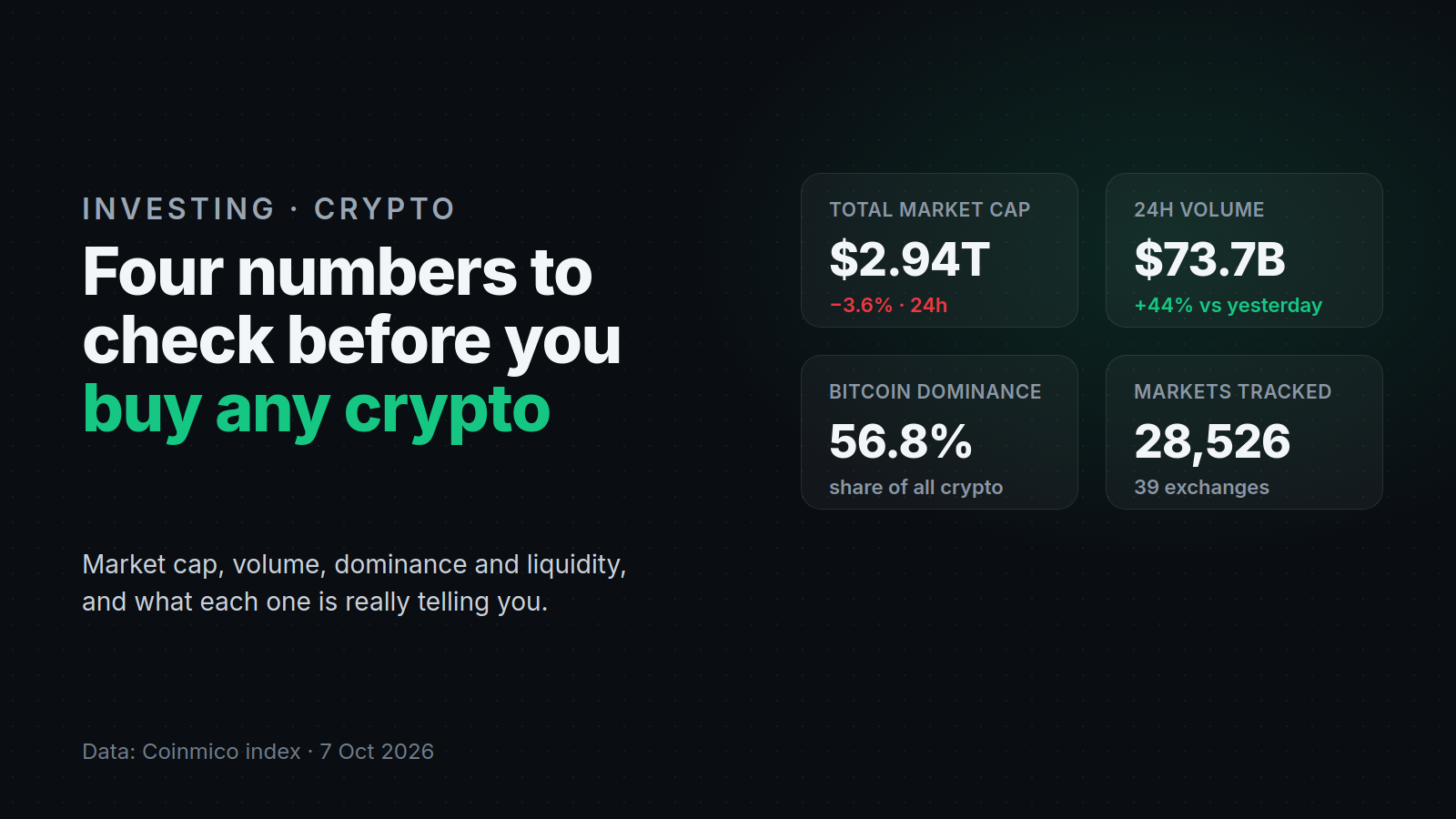
Market cap is the price of one coin multiplied by the number of coins in circulation, exactly as with shares. It is the only honest way to compare two coins, because a “cheap” coin at $0.002 with a trillion units in circulation is worth far more in total than a “dear” one at $500 with a few million. The whole crypto market is currently worth about $2.94 trillion, according to Coinmico, an independent market data site that measures the figure across 2,500 coins. For scale, that is less than the value of Apple or Microsoft alone, which tells you something about how early and how volatile this asset class still is.
One refinement is worth knowing. Most data sites show two versions of market cap: the circulating figure, based on coins that can be traded today, and the fully diluted valuation, which counts every coin that will ever exist. When the gap between the two is wide, a large share of the supply is still locked up with founders, early backers or reward schemes, and it will reach the market over the coming months or years. New supply has to be absorbed by new buyers, so a coin can drift lower even while the project itself does well. If the fully diluted figure is several times the circulating one, look up the token unlock schedule before you buy.
Market cap also helps you set realistic expectations. A coin worth $50 million can, in theory, rise tenfold far more easily than one already worth hundreds of billions. The same logic works in reverse: small caps fall faster and further, and many never recover. Treat a small market cap as a sign of higher risk, not just higher potential.
Trading volume
Volume is how much of a coin changed hands in the past 24 hours. Across the whole market it was roughly $74 billion on the day I checked. For an individual coin, volume answers a practical question: if I buy this and want to sell next month, will there be anyone to sell to? A coin with a $500 million market cap but only $200,000 of daily trading is a trap; the price exists on paper, but any meaningful sale would move it. As a rough rule, professionals grow wary when daily volume is below one or two per cent of market cap. Treat reported volume with some scepticism too: smaller exchanges have been caught inflating theirs, and the better data sites exclude or flag them.
A quick way to apply this is the volume-to-market-cap ratio. Divide 24-hour volume by market cap: a coin worth $1 billion with $30 million of daily trading has a ratio of 3 per cent, which is healthy for most mid-sized coins. Watch for sudden spikes as well. A burst of volume with no news behind it is often a sign of coordinated buying ahead of a sell-off, and it rarely lasts. Look at volume across a week or a month rather than a single day, because one busy session says little about whether buyers will still be there when you need them.
Bitcoin dominance
Dominance is Bitcoin’s share of the total market, currently about 57 per cent, with Ethereum a distant second at around 11 per cent. It is the crypto equivalent of a risk gauge. When dominance rises, money is retreating into the oldest, most liquid asset; when it falls, investors are venturing into smaller coins in search of higher returns. If you own altcoins and dominance is climbing steadily, the market is telling you something, whatever the headlines say.
Dominance works best as context rather than as a trading signal. It moves slowly, and a shift of a few percentage points over several weeks matters more than a daily wobble. Bear in mind too that stablecoins, which are designed to hold a steady dollar value, make up a meaningful slice of the total market. When investors sell into stablecoins during a downturn, the total market cap moves less than you might expect while the share held by riskier coins shrinks, so it is worth glancing at both numbers together.
Where it trades
The number investors most often skip is the simplest: how many exchanges list the coin, and which ones. A coin traded on a dozen reputable venues has a real, contestable price. A coin available on one obscure exchange has whatever price that exchange says it has. Coinmico’s exchange rankings currently cover 39 venues and more than 28,000 trading pairs, with a score for each exchange based on liquidity, volume quality and transparency, which is a quick way to judge whether the place a coin trades is one you would trust with a bank transfer.
Beyond the number of venues, look at the spread: the gap between the highest price a buyer will pay and the lowest price a seller will accept. On a well-traded coin it is a fraction of a per cent. A spread of several per cent means you are losing money the moment you buy. It is also worth checking where most of the volume sits. If 80 or 90 per cent of a coin’s trading happens on a single exchange, one delisting, outage or regulatory problem could leave you with no easy way to sell.
A five-minute checklist before you buy
Before you put money into any coin, run through these five questions:
- Is the circulating market cap large enough for the level of risk you are comfortable with, and how far below the fully diluted valuation is it?
- Is daily volume at least 1 to 2 per cent of market cap, and steady over several weeks rather than spiking?
- Is Bitcoin dominance rising or falling, and what does that say about the market’s appetite for risk right now?
- Does the coin trade on several reputable exchanges, with a tight spread and no single venue dominating its volume?
- Can you explain in a sentence what the project does and why anyone would want to hold its token?
A “no” to any of these does not automatically rule a coin out, but it should make you think about buying a smaller amount, or waiting until the picture is clearer.
Mistakes that catch new investors out
The most common error is judging a coin by its unit price. A token priced at a fraction of a cent is not a bargain just because the number looks small; what matters is the total value the market places on all of its units. A second is trusting a single source. Figures differ between data sites depending on which exchanges they include, so check two before acting on any number that looks unusual. A third is forgetting about costs. Trading fees, withdrawal charges and tax on any gains can eat a large part of a short-term profit, so work them out before you trade, not after.
Finally, many investors check these numbers only once, at the moment they buy. Market cap, volume and exchange listings all change, sometimes quickly. Reviewing your holdings against the same four figures every month or so takes little effort and helps you spot a coin that is quietly losing liquidity before it becomes a problem.
Putting it together
None of these numbers tells you whether a coin will go up. What they tell you is whether you are looking at an investable asset or a lottery ticket dressed as one: large enough to matter, liquid enough to exit, trading somewhere credible, in a market that is currently leaning towards or away from risk. Ten minutes with those four figures will not make you a crypto expert. It will, however, stop you making the mistakes that account for most of the horror stories, and that is a reasonable return on ten minutes.
Frequently asked questions
What is a good market cap for a cryptocurrency?
There is no single right figure. Coins worth more than about $10 billion are generally treated as large caps, with deeper liquidity and more stable prices, while those below $1 billion carry noticeably more risk. Match the size of the coin to how much volatility you are prepared to live with.
Is high trading volume always a good sign?
Not always. Steady, consistent volume is healthy because it shows a coin has a reliable pool of buyers and sellers. A sudden surge with no obvious cause can point to manipulation or a short-lived pump, so look at how volume behaves over several weeks before reading too much into a single day.
Why does Bitcoin dominance matter if I don’t own Bitcoin?
Because it reflects how willing investors are to take risks across the whole market. Falling dominance often coincides with gains in smaller coins, while rising dominance tends to mean money is moving back to safety, which is usually a harder environment for altcoins.
How often should I check these numbers?
Check all four before you buy, then roughly once a month while you hold the coin. Look sooner if its price or volume moves sharply, or if you hear that a major exchange is reviewing or removing it.
This article is for general information only and is not financial advice. Cryptocurrencies are highly volatile, and you should only invest money you can afford to lose.